Best Spot Check Dye Penetrant Kit for Quick NDT Inspections
Dye penetrant testing is a nondestructive method used to reveal surface-breaking defects in materials. This guide focuses on a selection of spot check dye penetrant kits designed for fast, in-field inspections and maintenance workflows. Each kit includes penetrating dye, developer, and cleaners to help users quickly spot cracks or flaws. The following products are chosen for reliability, compatibility with common standards, and ease of use in both industrial and laboratory settings.
| Product | Brand | Type | Notes |
|---|---|---|---|
| CANTESCO D101-A Dye Penetrant Standard Developer | CANTESCO | Developers & Dye Penetrant | Non-aqueous wet developer, 12 oz aerosol |
| CANTESCO P101S-A Red Visible Dye Penetrant | CANTESCO | Dye Penetrant | Solvent removable, nuclear grade potential |
| CANTESCO C101-A Dye Penetrant Solvent Cleaner | CANTESCO | Cleaner/Remover | Meets AMS 2644 and ASME V, halogen/cloride free |
| Spotcheck 01-5155-77 Dye Penetrant, Red | Spotcheck | Dye Penetrant | Red penetrant, 16 oz |
CANTESCO D101-A Dye Penetrant Standard Developer

The D101-A combines dye penetrant with a non-aqueous wet developer in a 12 oz aerosol, enabling rapid surface inspection workflows. Its package dimensions are compact, facilitating use in tight spaces or field environments. This option is suitable for standard surface flaw detection where quick wipe-off and reveal steps are required, and it aligns with common non-destructive testing practices.
CANTESCO P101S-A Red Visible Dye Penetrant

The P101S-A is a red visible dye penetrant that is solvent removable, designed for clear contrast on test surfaces. It meets AMS 2644 and ASME section V requirements and is noted for nuclear-grade suitability with halogen and chloride-free formulation. This makes it a strong choice for industries requiring high standards of material integrity and traceability.
CANTESCO C101-A Dye Penetrant Solvent Cleaner

The C101-A cleaner/remover is designed to clean surfaces prior to inspection and to remove residual penetrant after testing. It meets AMS 2644 and ASME V standards, and its nuclear-grade, halogen- and chloride-free formulation supports demanding safety requirements in regulated environments.
Spotcheck 01-5155-77 Dye Penetrant, Red
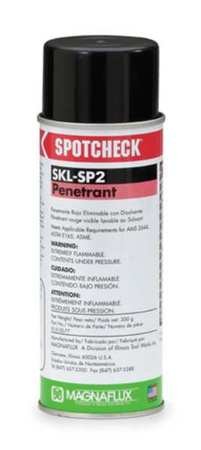
Spotcheck’s 01-5155-77 red dye penetrant is a widely used option under the Spotcheck line. It is marketed as an American-made product and positioned within a range of welding and soldering supplies. It provides strong surface reveal capabilities and is suitable for standard spot checks across various metals and surfaces.
Buying Guide
Selection factors
- Compatibility with standards: Look for penetrants and cleaners that meet AMS 2644, ASME Section V, or other relevant industry specifications to ensure acceptance in regulated projects.
- Penetrant type: Red penetrants improve visibility on many metals; solvent-removable variants can enhance cleanup efficiency in busy environments.
- Developer formulation: Non-aqueous and aerosol developers offer quick application and fast reveal times, useful for spot checks and field jobs.
- Remover and cleaner options: A dedicated cleaner/remover helps remove excess penetrant after inspection, reducing false indications on subsequent tests.
- Safety and materials: Consider halogen- and chloride-free formulations, especially in nuclear or corrosion-sensitive contexts.
- Ease of use: Aerosol cans and compact packaging suit on-site inspections where portability matters.
- Environmental and disposal considerations: Choose products with clear disposal guidelines and minimal hazardous byproducts where possible.
Performance considerations
- Contrast and visibility: Red penetrants typically provide high contrast against most base metals, aiding defect detection during quick inspections.
- Surface cleanliness: Proper cleaning before applying penetrant reduces false negatives and improves defect reveal.
- Removal efficacy: Efficient solvent removers help in rapid turnaround when inspecting multiple parts in a single shift.
- Compatibility with materials: Verify that the penetrant and cleaner are compatible with the tested material’s metallurgy and surface finish.
Application tips
- Apply penetrant evenly and allow adequate dwell time to ensure penetrant penetration into surface-breaking defects.
- Wipe off excess penetrant before applying developer to enhance flaw visibility.
- Inspect under proper lighting and, if needed, use magnets or aids to stabilize parts during inspection.
- Document results clearly, noting part numbers, date, and any observed indications for traceability.
Perspective considerations
- Industrial reliability: For maintenance programs, select combinations of penetrant and cleaner that balance speed with accuracy to minimize downtime.
- Regulatory compliance: In regulated sectors, adhere to required standards and material specifications to ensure audit readiness.
- Cost efficiency: When evaluating kits, consider total cost of ownership, including consumables, disposal, and training requirements.