Best Precision Gas Flow Meter for Accurate Shielding Gas Control
Precision gas flow meters help welders and technicians measure shielding gases with confidence, reducing waste and improving consistency. This guide highlights five dependable options designed for MIG/TIG welding, laboratory testing, and industrial gas control. Each entry includes a quick overview, key features, and practical considerations to help you choose the right device for your setup.
| Product | Brand | Model / Range | Key Use |
|---|---|---|---|
| Sxstar Argon Co2 Professional Gas Flow Meter Tester | Sxstar | 0-25 LPM | Welding torch gas flow test |
| Profax Gas Flow Meter – PX 50020 | Profax | Up to 25 LPM (52 CFH) | Shield gas measurement for welding |
| VQP Digital Gas Flow Meter | VQP | 0-20 LPM | Portable testing for various gases |
| Walfront Flowmeter 2-20 LPM | Walfront | 2-20 LPM | General gas flow control |
| JIAWANSHUN Oxygen Air Flow Meter | JIAWANSHUN | 0.1-1.5 LPM | Oxygen flow measurement |
Note: This article evaluates devices suitable for precise gas flow measurement in welding and related applications. Always verify compatibility with your gas type and operating environment before purchasing.
Sxstar Argon Co2 Professional Gas Flow Meter Tester

The Sxstar gas flow tester is designed as a peashooter-style tester with a 0-25 LPM scale, marked in one-liter increments. It is intended for testing shielding gas flow at MIG or TIG torches and can accommodate various gases. Quick attachment over the gas nozzle provides a direct read from the top of the ball. This model emphasizes straightforward operation and visual accuracy for on-tly-weld setups, making it suitable for shop environments where quick checks are routine.
Key considerations:
– Range suitable for typical shielding gas flows in common welding tasks.
– Simple, non-digital display reduces complexity in busy shops.
– Compatible with multiple gases; ensure the nozzle interface matches your equipment.
Profax Gas Flow Meter – PX 50020
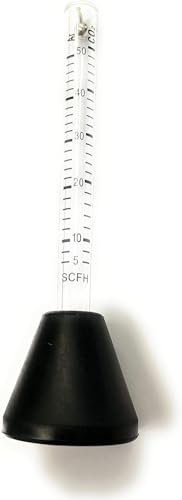
The Profax PX 50020 measures argon and CO2 flow up to 25 LPM (52 CFH), focusing on actual shielding gas delivery at the welding torch. Its design targets weld quality consistency by monitoring the gas supply precisely where it matters most. This model is commonly chosen by professionals aiming to optimize gas usage and reduce variability in welds, especially in high-precision tasks.
Key considerations:
– Targeted range for shield gas at the torch.
– Prospective cost savings through reduced gas waste.
– Ensure compatibility with your torch connections and fittings.
VQP Digital Gas Flow Meter

The VQP device is a MEMS-based digital flow meter that emphasizes high sensitivity and quick start flow. It features an LCD display showing instantaneous and cumulative flow, plus battery status. Suitable for air, nitrogen, oxygen, and other inert gases, the meter supports 0-20 LPM with a compact form factor and no need for extensive temperature or pressure compensation. It is well-suited for portable field testing and lab environments where quick reads are essential.
Key considerations:
– Digital readout simplifies data logging.
– MEMS sensing provides responsive measurements at low flow.
– Note the device’s range and ensure it covers your typical test conditions.
JIAWANSHUN Oxygen Air Flow Meter

The JIAWANSHUN device targets oxygen flow measurement with a range of 0.1-1.5 LPM and a copper connector. This flow meter is designed for oxygen and other single-phase non-pulsating gas flows, providing a precise reading for controlled oxygen delivery. Its compact design makes it suitable for confined spaces or cartridge-style gas systems where precise regulation is critical.
Key considerations:
– Narrow flow range tailored for oxygen and similar gases.
– Copper connector suited to specific hose assemblies.
– Best for applications requiring tight oxygen flow control rather than high-volume gas delivery.
Buying Guide
- Flow range and gas compatibility: Compare the typical shielding gas flow in your welding tasks with the meter’s range. Ensure the device supports argon, CO2, nitrogen, oxygen, or others you use.
- Display and data recording: Digital LCD meters offer instantaneous and cumulative readings, aiding in documentation and process control. Mechanical meters are simpler and faster for quick checks.
- Construction and environment: Consider material durability, weather resistance, and whether the meter is rated for dry or damp conditions. Some meters are not weatherproof and should be used indoors or sheltered areas.
- Connection interfaces: Check hose barb sizes and fittings to ensure compatibility with your TIG/MIG torch and gas lines. Adapters may be required for some models.
- Portability and form factor: For field work, compact and lightweight meters with easy attachment to welding rigs are advantageous; for shop use, larger, more robust units may be preferable.
- Maintenance and calibration: Some meters require minimal maintenance, while others may need periodic calibration or replacement parts to maintain accuracy.
- Cost-effectiveness: Weigh upfront cost against gas usage savings and potential improvements in weld consistency. Durable meters with reliable readings can reduce waste over time.
- Quality signals: Look for clear readouts, stable readings, and reputable brands. User reviews and warranty terms can provide insight into long-term performance.
When selecting a precision gas flow meter, align the device with your typical gas types, weld processes, and maintenance capabilities. If you perform frequent welding with argon or CO2 shielding, a meter with a clear readout, appropriate range, and robust connectors will deliver the most value. For occasional testing or field work, a compact digital option with easy portability may be more suitable. Always verify that the device’s specifications meet your specific application requirements before purchase.