Best Personal Gas Detectors for Confined Spaces and Safety
Confined spaces pose unique dangers from toxic gases and oxygen deficiency. This guide highlights five reliable personal gas detectors designed for rapid detection of H2S, CO, LEL, and O2, with robust alarms and long battery life. Each device supports workers in industrial, home, and DIY environments, ensuring quick alerts and easy data access for safety records. below is a concise summary of the selected products to help you compare at a glance.
| Product | Gas Types Detected | Key Features |
|---|---|---|
| TopTes Guard-101 | H2S, CO, LEL, O2 | Triple alarm (LED, vibration, sound); 14h battery; explosion-proof design |
| TopTes Guard-863Pro | H2S, CO, LEL, O2 | TFT color display; 5-year O2 sensor; USB data export |
| Forsensal Gas Detector With Pump | CO, O2, H2S, LEL | With pump; 3000mAh battery; calibration kit; easy records |
| BW Technologies MCXL-XWHM-Y-NA | CO, H2S, LEL, O2 | One-button operation; lightweight; reliable safety |
| ACEGMET MG10 | CO, O2, H2S, LEL | Type-C charging; 14h battery; triple alarms |
TopTes Guard-101 Gas Detector Review
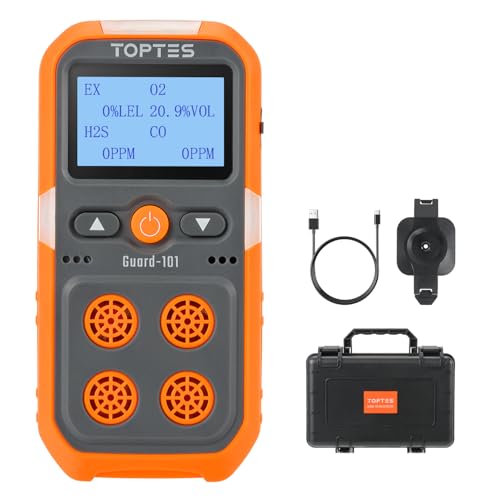
The Guard-101 is a compact 4-gas monitor designed for rapid detection of H2S, CO, LEL, and O2. Its 14-hour battery life supports extended work shifts in confined spaces, and the device favors rugged environments with waterproof, dustproof, and explosion-proof construction. A back clip enhances mobility, while password protection helps prevent accidental operations, starting with a default code of 69. Alarm modes include LED indicators, vibration, and audible alerts, and the model stores alarm records for later review, supporting safety compliance and incident investigations.
TopTes Guard-863Pro 4 Gas Monitor

The Guard-863Pro offers professional-grade detection with fast 0.5-second response across four gases and international safety certifications. It features a TFT color display for real-time readings, easy data export via USB, and a robust triple-alarm system (sound, light, vibration) that continues until readings return to safe levels. The upgraded oxygen sensor extends service life to about five years, improving long-term reliability in challenging environments.
Forsensal Gas Detector With Pump

This 4-gas detector includes a pump option, enabling active sampling for precise gas concentrations in difficult-to-reach areas. It monitors CO, O2, H2S, and LEL, and ships with a calibration certificate. An initial password is set to 4321, and the device provides a large display, ease of navigation through its menu, and the ability to review records and trends. It also includes a long-lasting rechargeable battery and a comprehensive accessory set for field use.
BW Technologies MCXL-XWHM-Y-NA MicroClip XL

The MicroClip XL provides four-gas detection (CO, H2S, LEL, O2) in a compact form suitable for ongoing surveying and personal safety. It is lightweight and designed for easy wear, with one-button operation to simplify training and use in the field. This detector is appropriate for routine checks in industrial or training settings where ease of use and quick readings are critical.
Forensics Detectors FD 4 Gas with Pump

This 4-gas monitor includes a USB recharge option and a calibration kit, with USA NIST calibration and a pump kit for enhanced sampling. It covers O2, CO, H2S, and LEL, and offers adjustable audible, visual, and vibration alarms with a clear digital timestamp for alarms and logs. The device emphasizes calibration traceability and reliable performance for safety-critical tasks.
XLA Alert Portable 4 Gas Monitor

The XLA Alert 4-gas monitor is designed for quick detection across LEL, O2, CO, and H2S with a rugged, portable aluminum alloy housing and an ABS body. It features a bright LCD for easy reading, human voice alerts, and adjustable alarms. The device is suitable for confined spaces and fieldwork where dependable, audible and visual warnings are essential, even in bright outdoor conditions.
USA NIST Calibrated 4 Gas Monitor (Forensics)

This USA NIST-calibrated 4-gas monitor provides O2, CO, H2S, and LEL detection with high-precision electrochemical sensors. It boasts a fast < 30-second response and supports zero and span calibrations. Adjustable alarms (audio, visual, vibration) and a digital timestamp provide traceable safety data, making it suitable for industrial compliance and safety audits.
ACEGMET MG10 Gas Detector

The MG10 combines fast detection with a Type-C charging system for rapid recharging and a 14-hour battery life. It monitors CO, O2, H2S, and LEL in real time, with triple alarms (audible, visual, and vibration) to ensure warnings are noticed even in noisy spaces. The device is built with safety in mind for both worksite and home use.
Buying Guide: Key Considerations When Choosing a Personal Gas Detector
- Gas coverage: Ensure the detector reads the specific gases you may encounter (H2S, CO, LEL, O2, etc.) for confined-space work.
- Response time and alarms: Look for rapid detection (<1 second) and a multi-modal alarm system (audible, visual, vibration) to accommodate noisy environments and visually impaired users.
- Sensor life and calibration: Consider sensors with longer lifespans (e.g., 5-year O2 sensors) and options for calibration certificates or NIST traceability for compliance.
- Power and longevity: Battery life matters for long shifts; options with 12–18 hours or more are advantageous in confined spaces.
- Durability: For field use, choose rugged devices with waterproof, dustproof, and explosion-proof ratings and protective housings.
- Data logging and export: USB or other data export helps maintain safety records, trends, and compliance documentation.
- Ease of use: Simple interfaces, clear displays, and straightforward operation reduce training time and improve response in emergencies.
- Accessories: Pump vs. diffusion sampling, calibration kits, and clip-on designs can impact how you conduct sampling in tight spaces.
- Price vs. value: Balance upfront cost with sensor quality, battery life, warranty, and data management features to fit your safety program.
- Regulatory alignment: If your industry requires specific standards or certifications, verify compatibility with your regulatory framework.
Choosing a personal gas detector for confined spaces involves aligning the device’s capabilities with the work environment, required gas coverage, and record-keeping needs. The models above offer a range of hardware configurations, from pump-assisted sampling to compact wearables, each delivering reliable alerts to support worker safety.