Best Molten Metal Pouring Ladles for Foundry and Hobby Use
Choosing a reliable molten metal pouring ladle is essential for safe and precise metal casting. This guide highlights top ladles designed for control, durability, and ease of use. We compare capacity, handle length, material, and pour features across five select products to help you pick the right tool for your project.
| Product | Brand | Key Features | Approx. Cap./Weight |
|---|---|---|---|
| Casting Ladle Bottom Pour Rowell #2 | Roto Metals | 2-1/2″ bowl, 16″ length, 2 lb lead capacity, wooden grip | 2 lb |
| Casting Ladle Bottom Pour Rowell #1 | Roto Metals | 2-1/4″ bottom pour bowl, 9″ wooden grip, 1 lb lead capacity | 1 lb |
| Casting Ladle Bottom Pour Rowell #3 | Roto Metals | 3″ bowl, 14″ metal handle, 4 lb lead capacity | 4 lb |
| Casting Ladle Bottom Pour Rowell #5 | Roto Metals | 5″ bowl, 24″ sliding sleeve handle, 9 lb lead capacity | 9 lb |
| OXO Good Grips Stainless Steel Ladle | OXO | Dual pour spouts, angled design, stainless steel | Varies by size |
The following sections present five top options with detailed specifications, benefits, and practical notes to help you assess suitability for molten metal pouring tasks, hobby casting, or workshop use.
Casting Ladle Bottom Pour Rowell #2 — 2 lb Capacity

The Rowell #2 ladle from Roto Metals features a 2-1/2″ bowl diameter and a 2-pound lead capacity, making it suitable for small to moderate pours in metal casting projects. It uses a 4″ wooden grip handle and an overall length of 16″, balancing control with reach. This configuration supports steady pours with a traditional wooden grip that remains cool with careful handling. Consider this option when you need reliable tipping action without sacrificing precision in a compact tool.
Casting Ladle Bottom Pour Rowell #1 — 1 lb Capacity

Rowell #1 from Roto Metals uses a cast iron bottom pour bowl with a 2-1/4″ diameter, aimed at lighter pours. It includes a 9″ wooden grip handle and a 1-pound lead capacity. The smaller bowl is well-suited for refined pours or detail work where minimal metal transfer is desired. The cast iron construction provides durability for repeated use in metal casting or alloy experiments.
Casting Ladle Bottom Pour Rowell #3 — 3″ Bowl

Rowell #3 offers a larger 3″ bowl diameter and a 4 lb lead capacity, with a 14″ integrated metal handle. This setup provides greater pouring mass for higher-volume casts while maintaining control. The integrated metal handle adds durability and steadiness, especially when handling hotter metals in longer pours. Choose this for mid-size molds or projects requiring more material per pour.
Casting Ladle Bottom Pour Rowell #5 — 5″ Bowl

The Rowell #5 ladle features a 5″ bowl capacity with a substantial 9 lb lead capacity and a 24″ sliding sleeve handle. This design is intended for large pours or situations where gravity feed over longer distances is needed. The sliding sleeve handle improves control and stability during extended pours, making it suitable for more demanding foundry tasks or larger scale projects where efficiency matters.
OXO Good Grips Stainless Steel Ladle
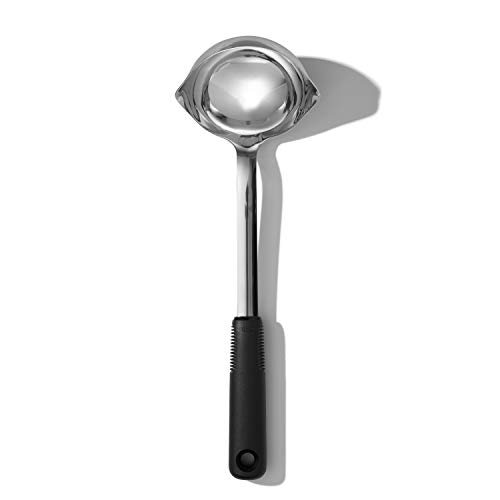
The OXO Good Grips ladle offers a stainless steel option with dual-sided pour spouts for right- and left-handed users. Its angled design helps keep liquids in the ladle during scooping, reducing drips and spills. While designed for kitchen tasks like soups and gravies, its sturdy construction and ergonomic grip can be advantageous for controlled pouring in smaller metalworking setups or hobby casting where precision and clean pours are valued.
Pittsburgh Foundry Molten Metal Ladle Poster Print

Historically styled representations can provide context for traditional ladle designs used in foundry operations. This item features a vintage scene of a ladle pouring molten steel, depicted as a poster print. It serves as wall art or educational decor for metalworking studios, but it is not a functional tool for processing materials.
Buying Guide
Key purchase considerations for molten metal pouring ladles include material and heat tolerance, ladle capacity, bowl diameter, handle design, and overall ergonomics. When selecting a tool for metal casting, evaluate the following perspectives:
- Capacity vs. project size: Smaller bowls (1–2 lb) are ideal for detailed runs and molds with tight tolerances, while larger bowls (4–9 lb) support higher-volume pours in bigger molds.
- Material and heat management: Cast iron and steel ladles offer durability; wooden handles stay cooler but may require more care. Stainless steel provides corrosion resistance and a clean surface for repeated use.
- Pour control features: Integrated or sliding sleeves, pour spouts, and ergonomically shaped handles improve accuracy and reduce drips. Consider left- or right-handed pourability if needed.
- Durability and maintenance: Heavier, solidly built ladles withstand repeated heating cycles. Ensure handles and joints are secure and that cleaning methods align with material choices.
- Safety and workflow: Choose tools with balanced weight distribution to minimize wrist strain. Plan your setup to keep hot metal away from skin and flammable materials, and use heat-resistant gloves and eye protection during pours.
- Combination use: For hobbyists, a mix of a moderate-capacity ladle (2–3 lb) and a larger-capacity option (5–9 lb) can cover most projects from small molds to bulk pours.
Compared options typically balance pour control with capacity. The Rowell line emphasizes capacity variations and grip designs for varying pour scales, while the OXO ladle prioritizes ergonomic handling and spill prevention in a kitchen-grade stainless steel form. For decor or educational purposes, poster prints offer historical context but are not substitutes for functional ladles in metal casting.