Best HDPE Pipe Fusion Welding Machine for Seamless Piping Projects
Choosing the right HDPE pipe fusion welding machine is essential for reliable, leak-free joints in water, gas, and irrigation systems. This guide reviews five capable models that cover a range of pipe sizes and fusion methods, helping professionals and DIY enthusiasts identify options that balance power, accuracy, and durability. Each product below is selected for versatility, build quality, and user-friendly features that support consistent fusion results.
Summary of chosen products:
- HQHAOTWU Pipe Fusion Welding Machine
- Hayes Digital Socket Fusion Pipe Welder Tool Kit PRO
- TBVECHI 2.48-6.3Inch Fusion Pipe Welder
- Pazcii Hdpe Pipe Fusion Welder 2 Clamps
- SHATUOA 2 Clamps Pipe Fusion Welder
HQHAOTWU Pipe Fusion Welding Machine

The HQHAOTWU fusion welder supports outer diameters of 2.48″ to 6.30″ (63 mm to 160 mm), enabling PE, PB, PVDF, and PPR piping. Key components include a 1.2 kW heating element and a 0.65 kW milling cutter, powered by 110V. The machine features widened, thickened clamps and a robust aluminum frame for stability, along with a dual-sided milling cutter blade for extended use. An independent heating plate with a dedicated bracket helps prevent scalding after welding, and an automatic pressure-maintaining device improves usability and consistency.
Core highlights include the multi-diameter range, durable construction, and thoughtful safety design. The alignment and clamping performance are geared toward minimizing docking deviations, aiding precise, repeatable welds in professional settings.
Hayes Digital Socket Fusion Pipe Welder Tool Kit PRO

This Hayes welding kit covers a range from ½ inch CTS to 2 inches IPS, with six heating faces that accommodate common pipe sizes from ½ in to 2 in. The unit operates on 110V, 50/60 Hz, drawing 800W. The design supports socket fusion welding with digital precision controls and dedicated heating surfaces, making it suitable for quick, reliable joints in small to medium piping projects. The kit’s included faces and compact form factor help streamline field installations or shop work.
Pros include broad size compatibility and a compact toolkit that consolidates essential elements for socket fusion tasks. The device is well-suited for contractors who frequently handle residential or light commercial pipelines requiring consistent socket joints.
TBVECHI 2.48-6.3Inch Fusion Pipe Welder
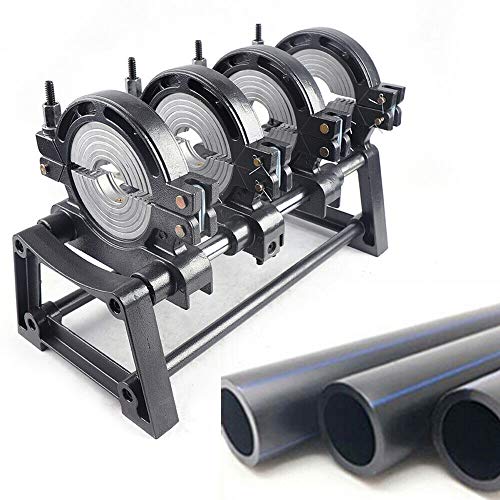
The TBVECHI fusion welder supports 2.48 to 6.3 inches, featuring a copper core motor for improved power delivery, a non-stick, high-heat plate with a Teflon coating, and a precise thermostat up to 300 degrees. An aluminum frame provides stability, while a red/green indicator system helps operators monitor temperature status. The machine emphasizes efficiency with a faster heating cycle and a robust design that aims to deliver accurate butt welds with less downtime.
Users benefit from the non-stick plate design and the gadget’s ability to maintain consistent temperatures during fusion, contributing to stable joints across typical HDPE, PE, and related piping materials.
Pazcii Hdpe Pipe Fusion Welder 2 Clamps

The Pazcii model emphasizes easier welding with a rocker-style handle, split structure, and a temperature control knob paired with a high-performance milling cutter. A pure copper motor delivers stronger power and higher efficiency, aiming to complete welding in under 20 minutes with lower noise. The double-ring fixation minimizes docking deviation to under 0.013 inches for precise butt joints. This design supports efficient, clean fusion across PE, PP, PB, and PVDF pipes in modest to mid-scale projects.
Key considerations include operator ergonomics, motor efficiency, and the double-ring fixation’s impact on joint accuracy, which can help reduce rework on challenging inline welds.
SHATUOA 2 Clamps Pipe Fusion Welder

The SHATUOA welder uses a two-clamp setup designed for 63–200 mm piping. It emphasizes a straightforward welding process with a split structure and a temperature control knob paired with a high-performance milling cutter. The unit’s pure copper motor provides solid power and efficiency, supporting welding tasks within a broad size range. Like other models, it aims to minimize noise during operation and deliver reliable fusion performance with a user-friendly workflow.
Considerations for this model include its compatibility with common HDPE/PPR/PVDF materials, the ease of adjusting temperature, and the overall rigidity of the frame for stable welds in field conditions.
Buying Guide: Key Considerations For Selecting An HDPE Pipe Fusion Welder
- Pipe size range: Ensure the machine covers your typical diameters (for example, 2.5 inches to 6.3 inches or larger) to minimize the need for multiple tools.
- Power and heating performance: Look for a heater power around 1.0–1.5 kW and a fast heating cycle to shorten welding times without sacrificing joint quality.
- Clamping and frame: A robust, widened clamp system and a rigid aluminum frame reduce movement during fusion, increasing joint accuracy.
- Temperature control: A precise thermostat with a clear indicator helps maintain correct fusion temperatures for various plastics (HDPE, PPR, PB, PVDF, PP).
- Maintenance features: Independent heating plates, anti-scald brackets, and docking guides minimize safety risks and simplify post-weld handling.
- Motor and drive quality: Copper-core motors typically offer better efficiency, cooler operation, and longer service life than aluminum-core alternatives.
- Portability and setup: If you work in the field, lightweight designs with simple assembly and compact kits reduce on-site downtime.
- Support and accessories: Consider whether the tool includes multiple heating faces or milling cutters, and whether spare parts are readily available.
- Reliability across materials: While HDPE is common, some welders also claim compatibility with PB, PVDF, and PP—verify material compatibility in specs.
When selecting a HDPE pipe fusion welder, balance capacity and precision with durability and safety features. For larger-scale projects, prioritizing a machine with a wider diameter range and sturdy construction will help ensure consistent weld quality. For contractors and DIYers focusing on smaller pipelines, a compact unit with quick heat and easy temperature controls may be more cost-effective and practical. Review the included accessories and after-sales support to maximize long-term value.