Best Grass Chaff Cutter Machine for Efficient Hay Processing
When selecting a grass chaff cutter, farmers and hobbyists look for durability, efficiency, and ease of use. This guide highlights five top options and compares their key features to help you choose the right model for your operation. Each product below is designed to process grass, straw, or hay into silage or animal feed with varying power, blade configurations, and feeding systems.
Summary of Selected Products:
| Product | Brand | Key Feature | Power | Blade Count |
|---|---|---|---|---|
| Banfluxion 220V 6-Blade Hay Cutter with Conveyor | Banfluxion | 6 thickened blades; auto feeding with conveyor | 3KW | 6 |
| HayWHNKN Chaff Cutter with Conveyor | HayWHNKN | Auto feed conveyor; adjustable cutting length | Unknown (3KW typical) | 4 |
| TXMACHINE Hay Cutter Machine 2.2KW | TXMACHINE | 2.2KW motor; 8 blades; conveyor option | 2.2KW | 8 |
| TXMACHINE 8-Blade Chaff Cutter (Without Motor) | TXMACHINE | 8 blades; compact design; manual motor separately | Without motor | 8 |
| HQHAOTWU Hay Cutter with Conveyor and Dust Collector | HQHAOTWU | 6 blades; cyclone dust collector | 220V | 6 |
Banfluxion 220V 6-Blade Hay Cutter with Conveyor

The Banfluxion unit relies on six thickened blades designed to cut various grasses and crop materials efficiently. Its thickened feeding port accommodates different grass lengths, and the machine includes a robust 3KW motor to support high production rates, reported to reach 500-1000KG/H. The model features doublist blade construction to extend blade life and a conveyor-equipped feeding system for continuous operation. Ideal for farmers seeking a capable, fixed-power cutter with automated feeding.
HayWHNKN Chaff Cutter With Conveyor

This HayWHNKN model comes with a four-blade setup plus a conveyor for automatic feeding. It emphasizes ease of use, with adjustable material length and configurable belt tension. The feeding port is widened and thickened to reliably handle various grasses, making it suitable for farms needing automatic feeding along with relatively simple blade replacement. It supports efficient processing with a flexible cutting length and space-saving design when not in use.
TXMACHINE Hay Cutter Machine 2.2KW
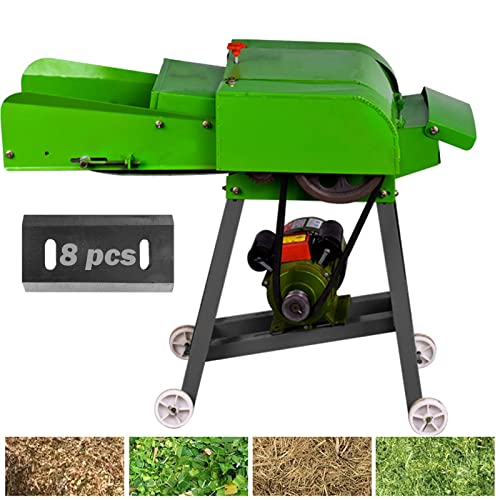
TXMACHINE’s Hay Cutter integrates a 2.2KW motor and eight high-hardness blades to deliver efficient chopping for grasses, corn straw, and similar materials. It features an automatic feeding option via a conveyor belt and offers a choice of operating voltages. The device is designed for medium-scale operations, delivering a balance between blade count, motor power, and throughput, with an emphasis on durable manganese steel knife construction for wear resistance.
TXMACHINE Chaff Cutter Hay Cutter Without Motor (With Optional Frame)

This TXMACHINE model provides an 8-blade configuration without an integrated motor, making it a flexible option for buyers who want to pair their own drive system or use with compatible power sources. It maintains a similar 22 cm cavity width as other TXMACHINE units and supports processing a range of straw and grass materials. The design emphasizes sturdy manganese steel knives and durability across varying feed lengths and farming contexts.
HQHAOTWU Hay Cutter With Conveyor And Dust Collector

HQHAOTWU combines a six-blade setup with a cyclone dust collector to minimize airborne dust and improve the working environment. It includes a conveyor feeding system for automatic intake and a 220V power setup. The combination of cyclone dust collection and multi-blade cutting makes it suitable for barns or sheds where dust suppression and steady throughput are priorities.
Buying Guide
Key considerations when choosing a grass chaff cutter machine include blade configuration, feeding system, power, throughput, and maintenance needs. Blade count affects cutting speed and texture; more blades generally mean finer chop but higher wear. Conveyor-fed models offer hands-free operation and consistent throughput, but require more space and upfront setup. Power (watts or kilowatts) influences throughput under heavy loads; higher power models are better for large volumes of grass and straw.
Other factors to evaluate:
– Feeding port design: A wider, reinforced port supports easier loading of thick or tangled grass.
– Durability: Look for hardened manganese steel knives and robust gear assemblies.
– Maintenance: Check for blade replacement ease and availability of spare parts.
– Noise and dust: Models with dust collection help limit cleanup and protect workers.
– Portability vs. fixed setup: Some units include wheels or compact frames, while others are designed for stationary use on a farm or workshop.
Compared to manual or smaller units, these machines generally provide higher throughput (often in the 400-1000 kg/h range) and more consistent chopping. For small homestead operations, a 2.2KW to 3KW model with an automatic feeding belt can offer efficient, nearly hands-off operation. For larger farming needs, selecting a heavier-duty model with six or eight blades and a robust conveyor is advisable to maintain steady output and reduce operator effort.
Safety and compatibility are important. Ensure the machine matches your local electrical standards and that guards, emergency stop features, and dust-management options are in place. When possible, review user manuals or supplier specifications to compare blade materials, mounting options, and service intervals to maximize longevity and performance.