Best Fiberglass Cloth for Boat Building: Top Picks for Decks, Hulls and Repairs
Choosing the right fiberglass cloth for boat building can improve resin saturation, reduce print-through, and simplify curved shapes or corners. This guide reviews five reliable options tailored for deck, hull repair, and structural reinforcement. Each product blends strength, flexibility, and resin compatibility to support durable marine laminates. Read on for a concise comparison and practical buying tips to help you select the best cloth for your project.
| Product | Width / Length | Weight | Best For |
|---|---|---|---|
| CRMCC Fiberglass Cloth Mat Roll | 50″ x 30 ft | 1.5 oz/yd² | Large surfaces, reduced seams |
| SIMOND STORE 6 Oz Fiberglass Cloth | 50″ x 12 ft | 6 oz/yd² | General repair, high tensile strength |
| SIMPLYHARDWARE Fiberglass Woven Mat Cloth | 50″ x 4 yd | 8 oz | Cures evenly, good for boats and roofs |
| Polymer World Polyester Resin with 1708x50x4.7 yd Cloth | 50″ x 4.7 yd | Not listed | Versatile resin compatibility |
| Acuteye Fiberglass Cloth Roll | 4″ x 99 ft | 6 oz/yd² | Repairing pipes, tanks, boats |
The table highlights a mix of mat rolls and woven cloth, wide formats for fast coverage, and varying weights to optimize resin absorption and surface finish. All options are designed for epoxy, polyester, or vinyl ester systems and suit common boat-building tasks from hull laminates to deck repairs and curved shapes.
CRMCC Fiberglass Cloth Mat Roll For Large Boat Projects

CRMCC offers a 50″ wide by 30-foot roll of chopped strand mat (CSM) designed for large laminations like boat hulls and panels. This 1.5 oz/ft² weight balances resin uptake with stiffness. The premium E-glass fibers and uniform distribution enable rapid saturation and strong surface lamination, reducing seam work and improving coverage across broad areas.
SIMOND STORE 6 Oz Fiberglass Cloth For Boats And More

This 6 oz woven roving cloth provides high tensile strength with dimensional stability and heat resistance. Its 50″ width supports sizeable boat surfaces or automotive panels with fewer seams. It’s compatible with epoxy, polyester, and vinyl ester resins, making it a versatile option for marine repairs and lamination projects.
VIKEYTIM Fiberglass Mat Roll For Repairs And Laminations
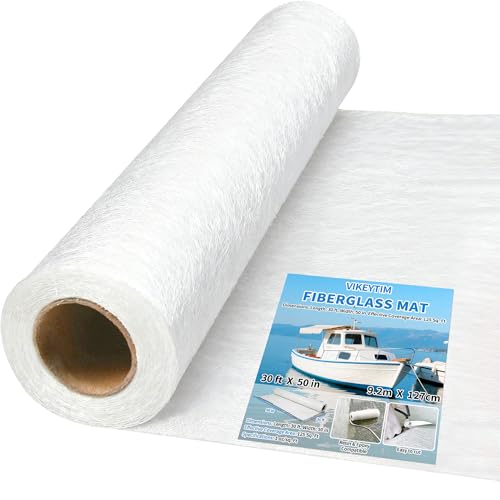
This 50″ wide x 30 ft long roll features 1 oz/yd² density with chopped strand construction. It’s designed for quick wet-out and uniform resin absorption, enabling efficient repairs and reinforcement for boats, roofs, and other large surface laminations. The mat helps create a sturdy, corrosion-resistant laminate with consistent thickness.
Polymer World 1708X Fiberglass Cloth For Marine Repairs

This rolled biaxial cloth combines fiberglass fibers with 1708-style weave, designed for fast wet-out and improved tackiness. It’s suitable for a wide range of boats, surfboards, and automotive projects, offering strong adhesion and uniform laminate thickness when used with compatible resins.
Generic Fiberglass Cloth For Curves And Corners
Generic 60″ wide cloth with a harness satin weave reduces wrinkling over curves and corners. It provides a smooth surface with less print-through, making it suitable for hull patches, decks, and curved panels where a tight weave yields a clean finish.
Buying Guide: Key Purchase Considerations
- Laminate type: Choose chopped strand mat (CSM) for bulk fill and reinforcement, or woven cloth for surface finish and high tensile strength in specific directions.
- Weight and thickness: Lower weights (<1 oz/yd²) saturate quickly and flex easily; higher weights (6–8 oz/yd²) build thickness and stiffness but require more resin.
- Width and length: Wide rolls reduce seams on large surfaces like hulls; longer lengths minimize joints in long repairs or decks.
- Resin compatibility: Ensure the cloth works with epoxy, polyester, or vinyl ester systems used in your project.
- Curves and corners: Look for fabrics marketed for corners, with tighter weaves or satin textures to minimize wrinkling and print-through.
- Load and application method: Consider whether you’ll hand layup, spray-up, or use roller saturation, which affects choice of mat vs. cloth weight and weave.
- Repair vs. new build: For repairs, prioritize repair-friendly cloth with good wet-out; for structural hull laminates, prioritize stiffness and uniform distribution.
- Storage and handling: Store in dry, cool conditions to prevent moisture uptake and degradation of resin absorption characteristics.
Selecting the right fiberglass cloth for boat building involves balancing coverage efficiency, resin uptake, and surface finish. The options above cover a range of project scales—from large hull laminations to curved deck patches—while offering reliable compatibility with common marine resins and application methods.