Best Carbon Fiber Mesh Sheets for Structural Reinforcement
Discover top carbon fiber fabric rolls and sheets designed for structural reinforcement on concrete, walls, basements, boats, and automotive projects. This guide highlights practical options with 2×2 twill weave, 3k filaments, and strong bidirectional strength to improve durability while keeping weight low.
| Product | Brand | Size (Width x Length) | Notable Feature |
|---|---|---|---|
| Jecery 6.5ft x 12″ | Jecery | 12 in x 6.5 ft | 2×2 twill weave, 0.25 mm thickness |
| Caliwill 6.5ft x 12″ (12k/400g) | Caliwill | 12 in x 6.5 ft | 12k/400g twill weave, corrosion resistant |
| Tudomro 4.17ft x 39.4″ | Tudomro | 39.4 in x 4.17 ft | 2×2 twill weave, 0.01 in thickness |
| Krbnk 3.3ft x 12″ | Krbnk | 12 in x 3.3 ft | High strength, 3K/220g, 2×2 weave |
| Tatuo 5 Rolls 6.5ft x 12″ | Tatuo | 12 in x 6.5 ft per roll (5 rolls) | 2×2 weave, 3k/220g, multi-roll set |
style=”visibility:hidden”>Introductory Summary
Below are five carefully selected carbon fiber fabric options that balance strength, weight, and ease of use. Each product features a 2×2 twill weave, 3k filament counts, and a width of 12 inches with a variety of lengths to suit different reinforcement tasks. The fabrics are designed for automotive, concrete wall, basement, boat, and furniture applications, offering resilient performance in corrosive or demanding environments.
Jecery Carbon Fiber Fabric Roll

The Jecery fabric roll measures about 12 inches (30 cm) in width and 6.5 feet (2 meters) in length with a thickness of 0.01 inch (0.25 mm). It uses a 2×2 twill weave with 3,000-filament tow, yielding a fabric that is soft yet strong. The material balances bidirectional strength with flexibility, making it suitable for reinforcing concrete walls, basements, boats, or automotive components. It is designed to resist bulging and maintain uniform stress distribution, while remaining easy to cut for custom shapes.
Caliwill Carbon Fiber Fabric Roll (12k/400g)
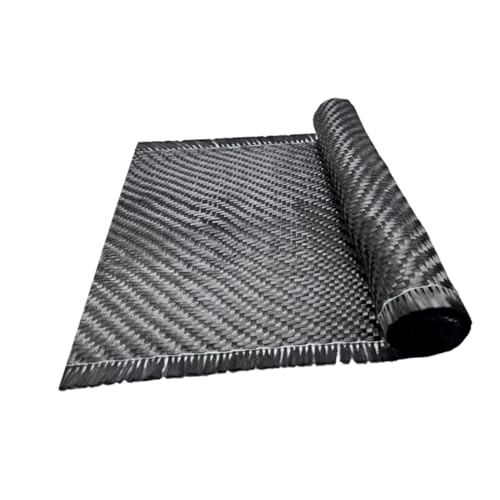
This Caliwill option runs about 12 inches wide and 6.5 feet long, with 12k/400g twill weave. The high filament count provides strong tensile strength while maintaining low density. The fabric remains lightweight, easy to cut, and compatible with high-acid, alkali, salt, and atmospheric environments. It offers corrosion resistance and minimal impact on the reinforced component’s weight and dimensions, making it suitable for structural reinforcement in automotive or construction projects.
Tudomro Carbon Fiber Fabric Roll

The Tudomro roll is about 39.4 inches (100 cm) in width and 4.17 feet (130 cm) in length with a 0.01 inch (0.25 mm) thickness. It uses a 2×2 twill weave with 3,000-filament tow, providing solid and serviceable reinforcement. The fabric is soft, flexible, and designed to resist bulging, offering bidirectional strength for uniform stress distribution. Its cuttable nature makes it suitable for complex shapes in walls, basements, or boats.
Krbnk Carbon Fiber Cloth Roll

The Krbnk fabric uses a 2×2 twill weave with 3K/220g filaments and a 12-inch width. This material emphasizes high strength and low density, with corrosion resistance and heat tolerance. It is designed as a professional-grade reinforcement option for DIY repairs or more extensive build projects, providing reliable performance across automotive and structural applications.
Tatuo Carbon Fiber Fabric Roll – Five Rolls

This multi-roll set includes five rolls, each measuring 12 inches (30 cm) wide and 6.5 feet (2 meters) long with a thickness of 0.25 mm. The 2×2 twill weave features 3k filaments (3,000) for bidirectional strength, flexibility, and ease of shaping. The set is suitable for multiple reinforcement tasks, allowing users to cover larger areas or multiple projects with consistent material quality.
Buying Guide: Key Purchase Considerations
- Weave pattern and orientation: A 2×2 twill weave provides good bidirectional strength and formability. Confirm both vertical and horizontal strength to ensure uniform stress distribution in reinforced components.
- Filament count and weight: Higher counts (e.g., 3k) offer greater strength but may impact thickness. Balance strength with ease of handling for your project.
- Thickness and weight: Common thickness ranges around 0.01 inch (0.25 mm). Thicker fabrics add rigidity but can be harder to cut or conform to complex shapes.
- Width and length: Standard width is 12 inches. Lengths range from a few feet to multiple rolls. Choose sizes that minimize waste for your project footprint.
- Corrosion and environmental resistance: Look for fabrics advertised as resistant to rust, acid, alkali, salt, and atmospheric exposure for outdoor or marine use.
- Cutting and handling: Materials described as soft, flexible, and easy to cut save time on shaping intricate contours and fixtures.
- Compatibility with DIY or professional use: Some products emphasize ease of use for DIY repairs, while others target professional-grade reinforcement.
- Packaging options: Multi-roll sets offer cost-effective coverage for larger projects and help maintain consistent material quality.
- Application scope: Consider whether you need reinforcement for concrete walls, basements, boats, or automotive components to select the most suitable fabric.
- Availability and sourcing: Ensure the product is readily available from reputable sellers and matches local project needs.