Best 5/8 Brass Tubing for DIY Projects: Top Picks
For mechanical, plumbing, and craft applications, 5/8″ brass tubing offers a balance of strength, conductivity, and workability. This guide highlights five reliable options that align with common project needs—from model making and jewelry to small-scale plumbing and HVAC components. Each product includes core specs and practical uses to help you compare durability, wall thickness, and length. The selections cover a range of uses, including thick-walled options for structural parts, telescoping designs for adjustable assemblies, and versatile brass tubes suitable for soldering and fabrication.
| Product | Brand | Length | Wall Thickness | Notes |
|---|---|---|---|---|
| Tynulox H62 5/8″ Brass Tube | Tynulox | 300 mm (11.8 inches) | 0.5 mm | 12G brass with good conductivity; seamless, corrosion resistant |
| K&S 8143 5/8″ Brass Tube | K & S Precision Metals | 12 inches | 0.014 inches | 260/272 alloy; versatile for plumbing, HVAC, crafts |
| YTKavq 5/8″ Brass Tubing | YTKavq | 12 inches | 0.5 mm | Thick-walled, ideal for knife making and models |
| K&S Telescopic 3-Tube Set | K & S Precision Metals | 12 inches (per tube) | 0.014 inches | Adjustable lengths; large telescopic assortment |
| Online Metals H58 5/8″ Tube | Online Metals | 12 inches | 0.065 inches | H58 temper; consistent dimensions across variants |
Product Highlights
Tynulox H62 5/8″ Brass Tube

The Tynulox H62 brass tube features a 5/8″ outer diameter with a 0.5 mm wall thickness, offering an inside diameter of approximately 16-15 mm and a 300 mm (11.8 inch) length. Made from H62 brass, it delivers good heat transfer and electrical conductivity while resisting corrosion, temperature, and pressure changes. This seamless round tube is suitable for general fabrication, DIY projects, and crafts that require sturdy, reliable brass tubing. It is sold as a single piece, enabling precise piece-by-piece integration into assemblies.
K&S Precision Metals Round Brass Tube 8143

These tubes are formed from a 260/272 brass alloy, combining strength and toughness for both indoor and outdoor applications. With a 5/8″ outer diameter and a thin 0.014″ wall, they are versatile for plumbing, HVAC, electrical, and mechanical projects. The smooth finish also makes them suitable for model building, jewelry, spacers, and DIY crafts that require easy cutting, soldering, and shaping.
YTKavq 5/8″ Brass Tubing, 0.02″ Wall

The YTKavq tubes use a robust 0.5 mm thick wall for enhanced strength and rigidity, making them well-suited for structural components in knife making, model building, and machinery. The 12″ length is sold in convenient two-packs, designed to minimize waste for hobbyists and DIY projects. They are easy to cut, solder, and polish with basic tools, enabling custom fabrication and decorative applications.
K&S 3-Tube Telescopic Brass Assortment
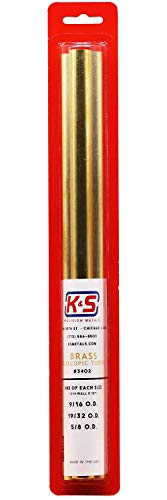
This assortment bundles three tubes in a telescoping layout, ranging from 9/16″ to 5/8″ OD, each 12″ long with a 0.014″ wall. The telescoping design enables adjustable lengths and configurations, ideal for DIY projects like building furniture accents, curtain rods, or custom structural components where length can be adapted on the fly. Brass compatibility supports easy soldering and finishing for clean, professional results.
MUELLER Copper Tubing Boxed (5/8″ OD x 20′)

Although copper, this boxed tubing set from MUELLER complements brass projects by offering a complete copper coil selection for general plumbing. It supports compatibility with sweat, brass, compression, or flare fittings, providing flexibility in mixed-material assemblies and repairs. It rounds out a brass-focused toolkit with complementary copper solutions for common HVAC and plumbing tasks.
Online Metals H58 Brass Tubing

Online Metals provides H58-tempered brass tubing with a 5/8″ outer diameter and a 0.489–0.495″ internal diameter range, depending on the specific variant. The 0.065″ wall thickness and 12″ length are common for structural and decorative uses in projects that require moderate rigidity, good machinability, and reliable performance across temperature ranges. The H58 designation indicates a balance of strength and ductility for general fabrication.
Online Metals H58 5/8″ Tube (36″ Length)
This 36″ length variant of the H58 brass tube extends project possibilities for longer spans and frames. Like the 12″ options, it maintains a 5/8″ outer diameter with a similar wall thickness profile, suitable for applications where extra length reduces assembly joins and improves structural integrity. It remains a practical choice for hobbyists and professionals assembling custom brass components.
Buying Guide: Key Purchase Considerations
- Material and alloy: Brass tubes come in several alloys (H62, 260/272, H58, etc.). Consider the environment and the required flexibility, corrosion resistance, and electrical/thermal properties for your project.
- Wall thickness and diameter: Thicker walls increase strength and rigidity but reduce internal diameter. Match wall thickness to the expected load and the need for soldering or threading.
- Length options: Short lengths are ideal for prototypes and hobby work; longer tubes reduce joints in larger builds but may add handling weight and waste if not needed.
- Form factor: Seamless tubes offer uniform strength, while pre-cut or telescoping tubes provide versatility for adjustable designs and model-making.
- Finish and machinability: Smooth finishes ease cutting, filing, sanding, and soldering. Brushed or polished finishes can affect aesthetic outcomes in decorative projects.
- Applications: Align the material with the intended use—plumbing, HVAC, model making, jewelry, or mechanical assemblies. Some tubes are easier to solder, while others excel in structural roles.
- Compatibility: If the project involves mixed materials (brass with copper or steel), ensure the joints, fittings, and adapters are compatible with the chosen tubing.
- Cost versus performance: Higher-strength alloys may offer long-term durability, but for many hobby tasks, standard 12″ to 24″ lengths in common alloys deliver adequate performance at lower cost.
In all cases, verify exact dimensions from the seller’s product page, and confirm fit with your project’s tolerances, especially when substituting a tube with a slightly different outer diameter or wall thickness. For critical assemblies, consider testing a small section before full-scale fabrication.