Best 3 Phase Monitor Relays for Industrial Panels and Systems
3 phase monitor relays are essential for safeguarding motor circuits and power systems by detecting phase loss, reversal, and undervoltage. This guide highlights five reliable options, with practical features for 190–500 VAC and common 208–240 VAC ranges. Each listing includes key specs, application notes, and where to buy. Use this overview to compare reliability, trip behavior, and maintenance needs across popular brands.
Summary of selected products
| Product | Brand | Voltage Range | Contacts | Key Features | Amazon URL |
|---|---|---|---|---|---|
| 3 Phase Monitor Relay, SPDT, 500VAC, 8 Pin | Macromatic | 190-500 VAC | 1 SPDT | 8-pin plug-in, 10 A, phase monitor | https://www.amazon.com/dp/B007ID7NNO?tag=praxusworksc-20 |
| 3 Phase Monitor Relay, SPDT, 240VAC, 8 Pin | Macromatic | 180-230 VAC | 1 SPDT | Phase loss/reversal, 4 s fail-safe, 10 A | https://www.amazon.com/dp/B005T8MI8U?tag=praxusworksc-20 |
| Macromatic PMPU 3 Phase Monitor Relay, SPDT, 500VAC, 8 Pin | Macromatic | 190-500 VAC | 1 SPDT | 10 A, 3-phase monitoring | https://www.amazon.com/dp/B005T8MGDW?tag=praxusworksc-20 |
| Dayton 31EE09 3 Phase Monitor Relay, SPDT, 500VAC, 8 Pin | Dayton | 500 VAC | 1 SPDT | Made in United States | https://www.amazon.com/dp/B07X7KSZJ7?tag=praxusworksc-20 |
| Time Mark A258B 3-Phase Monitor, 3PH, 480V | Time Mark | 480 VAC | SPDT | UL/CSA, manual/auto reset, 5-year warranty | https://www.amazon.com/dp/B01LX27QKM?tag=praxusworksc-20 |
Macromatic 3 Phase Monitor Relay, 500VAC

This Macromatic model provides a compact SPDT, 8-pin plug-in relay for 3-phase monitoring. It handles 190–500 VAC and enables reliable phase loss and reversal protection in motor circuits. With a 10 A resistive contact rating, it suits control panels, machines, and conveyors that require fast fault indication and straightforward wiring. Installers should verify the pickup and dropout ranges align with the system voltage to avoid nuisance tripping during startup transients.
Macromatic 3 Phase Monitor Relay, 240VAC
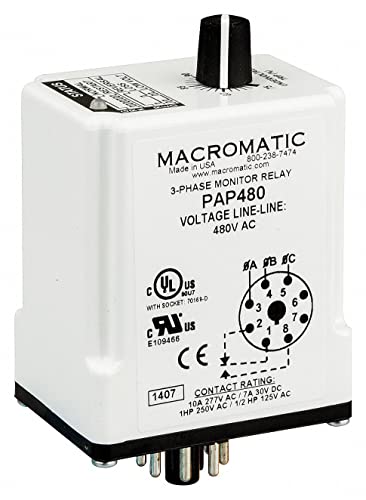
This model covers 180–230 VAC and includes typical protections for phase loss, phase reversal, and undervoltage with predefined trip delays. The device uses an octal 5X852 socket and offers a 10 A resistive load rating. It is suitable for small to mid-size equipment cabinets, where cost efficiency and simple maintenance are priorities. For installations with longer cable runs, ensure voltage drop is within the specified pickup range to maintain accurate fault detection.
Macromatic PMPU 3 Phase Monitor Relay

The PMPU variant is a dedicated 3-phase monitor relay featuring a SPDT contact with an 8-pin interface and 190–500 VAC operation. The 10 A load rating supports standard motor control circuits, fans, and pumps. Users should consider ambient temperature, vibration, and enclosure rating to ensure the relay remains reliable in harsh environments. Regular inspection of the input supply range will help prevent misdiagnosis of phase faults during startup surges.
Dayton 31EE09 3 Phase Monitor Relay

Dayton’s 31EE09 is a domestic option designed for 500 VAC operation with an 8-pin SPDT configuration. The model emphasizes American manufacturing quality and is positioned for panel builders seeking readily available, easy-to-wire relays. While it primarily focuses on reliability, verify compatibility with your system’s transformer and startup current to avoid misreads in voltage-sensitive installations.
Time Mark A257B Solid State 3-Phase Monitor

The Time Mark A257B is a solid-state 3-phase monitor with UL/CSA approval and a 480 V, 60 Hz specification. It detects phase loss, undervoltage, and phase reversal. The device supports both 50 Hz and 60 Hz systems and is suitable for critical process control where silent operation is required. When selecting a solid-state relay, consider the impact of leakage currents on downstream devices and the need for proper heat sinking in high-load environments.
Time Mark A258B 3-Phase Monitor

The A258B model adds practical features for 3-phase systems at 480 V, 60 Hz, with SPDT contacts. It offers UL/CSA credentials and an option for automatic or manual reset, backed by a five-year unconditional warranty. This makes it suitable for critical applications where a defined reset behavior and long-term reliability are priorities. Environment, electrical noise, and motor inrush should be considered to minimize false trips.
Macromatic 3 Phase Monitor Relay, 208Vac

This 208 VAC variant from Macromatic provides an economical option for mid-sized systems. It includes essential protections—phase loss, phase reversal, and undervoltage—with a 10 A resistive load rating. The 8-pin configuration and octal base simplify replacement in existing installations. Users should validate the exact pickup voltage range and ensure the wiring matches the octal socket to avoid misalignment with the control circuit.
Symcom Voltage Monitor, 3-Phase

Symcom’s 3-phase voltage monitor covers a universal 190–480 VAC range (and up to 600 VAC variants), with 50/60 Hz compatibility. It features four adjustment pots for flexible fault thresholds and LEDs to indicate trip status. This model suits global applications or multi-voltage facilities. When selecting, assess protection coordination with downstream relays and the ease of diagnosing LED indicators during fault events for faster maintenance.
Buying Guide: Key Considerations for 3-Phase Monitor Relays
- Voltage range and frequency: Match the relay to system voltage (190–500 VAC, 208/240 VAC, 50/60 Hz) and any 50/60 Hz compatibility requirements.
- Contact type and rating: SPDT is common; confirm amperage rating (usually 8 or 10 A resistive) and whether a normally open/closed configuration fits the circuit.
- Response and trip delays: Understand pick-up and drop-out ranges, fault delay times, and reset behavior (auto vs manual) to prevent nuisance trips during startup or transient spikes.
- Wiring and base type: Octal/sockets and plug-in formats ease replacement; verify enclosure, mounting, and lead length for your panel layout.
- Safety certifications: UL/CSA listings, warranty terms, and country of origin can influence long-term support and compliance.
- Environment and durability: Consider ambient temperature, vibration, and enclosure rating; solid-state options reduce mechanical wear but may introduce leakage concerns.
- Diagnostics and troubleshooting: Models with diagnostic LEDs or status indicators simplify fault isolation and preventive maintenance.
Choosing the right 3-phase monitor relay involves balancing voltage compatibility, fault detection speed, and the physical constraints of your control panel. For high-uptime operations, testing coordination with other protective devices and implementing a standard replacement plan can minimize downtime and ensure consistent protection across systems.