Best 3 Liter Erlenmeyer Flasks for Laboratory Use
For researchers and educators, a reliable 3 liter Erlenmeyer flask is a fundamental lab staple. This guide highlights top 3L flasks known for durability, accurate graduations, and practical design. Each featured option comes from trusted brands and is suitable for mixing, heating, and storage tasks in scientific settings.
Summary of selected products:
| Product | Brand | Capacity | Key Feature |
|---|---|---|---|
| Karter Scientific 213G16 | Karter Scientific | 3000 ml | Narrow mouth, printed graduations |
| United Scientific FG4980-3000 | United Scientific | 3000 ml | Graduation span 1000–3000 mL |
| Okulab EFNG3000A1 | Okulab | 3000 ml | Printed graduation |
| Utile 4016.3000.1 | Utile | 3000 ml | 3.3 borosilicate, printed graduations |
| LUERFLEX 3000ML | LUERFLEX | 3000 ml | Pack of 1, tolerance approx. ±5% |
Karter Scientific 3000ml Narrow Mouth Erlenmeyer Flask
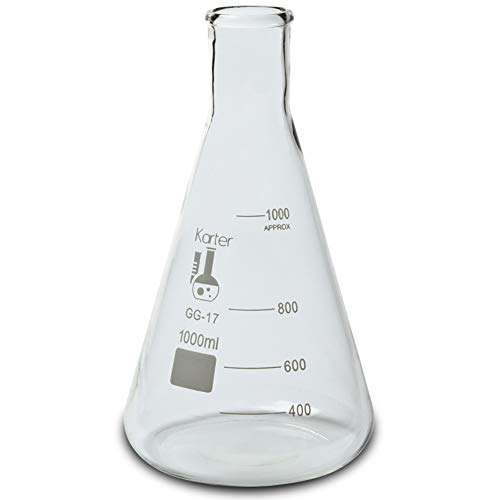
The Karter Scientific 213G16 Erlenmeyer Flask provides a generous 3000 ml capacity with a narrow mouth design. Graduations extend from 1000 ml to 3000 ml, enabling quick visual measurements during mixing and heating. The glass is 3.3 borosilicate, offering clarity and chemical resistance suitable for common lab solvents. With a compact height around 12.25 inches, this flask is easy to handle on benchtops and in fume hoods.
United Scientific FG4980-3000 3L Erlenmeyer Flask

United Scientific FG4980-3000 offers a 3000 ml capacity with a graduated range from 1000 to 3000 ml and 500 ml interval marks for quick dosing checks. Constructed from borosilicate glass, this flask emphasizes durability and chemical compatibility. The design supports safe swirling and heating, making it suitable for routine lab tasks and educational demonstrations where a clear measurement reference matters.
Okulab Conical Flask Set, 3L

Okulab EFNG3000A1 features a 3000 ml capacity with printed graduations for easy reference during experiments. The borosilicate glass is 3.3 quality, and the set emphasizes precise tolerances, stated as accurate within about 5 percent. This option suits classrooms and labs seeking dependable visual gauges for teaching demonstrations or multi-task experiments where repeated measurements are necessary.
Utile 3000ml Glass Erlenmeyer Flask

Utile’s 3000 ml Erlenmeyer combines a narrow mouth with printed graduations on 3.3 borosilicate glass. The uniform wall thickness and heavy-duty construction are designed for repeated heating and swirling. Its compact height and clear graduation space provide reliable visibility for routine lab tasks, making it a solid choice for teaching labs and research settings alike.
LUERFLEX 3000ML Erlenmeyer Flask

LUERFLEX’s 3000 ml Erlenmeyer Flask is offered as a single-pack option. It features 3.3 borosilicate glass with printed graduations and a tolerance of approximately ±5%. The product is designed for durability and accurate measurements, suitable for both educational labs and professional environments where consistent liquid handling is essential.
Buying Guide: Key Considerations For 3 Liter Erlenmeyer Flasks
Material quality matters. Most 3L flasks use borosilicate glass (3.3), which resists thermal shock and chemical attack better than soda-lime glass. When heating liquids, a thick-walled design and a stable base help minimize breakage risk and splashing during swirling.
Graduation accuracy and markings are important for experiments that require precise volumes. Look for printed graduations with clear, high-contrast markings, and consider tolerances around ±5% for general use. For classroom demonstrations, legible graduations can enhance learning outcomes.
neck design and mouth size influence pouring ease and splashing risk. Narrow-mouth flasks reduce sample loss during swirling, while broad-mouth variants may be easier to decant and clean. Choose based on your mixing technique and the solvents you typically handle.
Brand reputation and compatibility with common lab processes are practical factors. Established brands often offer better glass quality, accessory availability, and replacement policies. Consider whether the flask is compatible with common clamps, caps, and stoppers for closed-system experiments.
Weight, height, and overall handling also matter for storage and balancing on lab benches. A typical 3L flask reaches around 11–12 inches in height, depending on the neck and base dimensions. Ensure the chosen flask fits your storage racks and has a stable standability on work surfaces.
Cost and availability should align with your budget and procurement cycles. While price isn’t a replacement for quality, evaluating multiple options can help balance reliability, readability of graduations, and shipping considerations for ongoing lab needs.
Safety and cleaning considerations are essential. Glass flasks should be free of chips and cracks. Reputable products encourage smooth exterior surfaces for easy cleaning, and some sets include printed graduations that withstand repeated washing in standard lab detergents or solvent rinses.