Best 20 Mm Test Tubes for Science Projects and Classroom Experiments
Finding reliable 20 mm test tubes is essential for science classrooms, DIY experiments, and hobbyist chemistry. The following selections emphasize durable materials, clear visibility, and practical sealing options. This guide compares glass and plastic options across capacity, heat resistance, and storage flexibility to help you choose the right tubes for your needs.
Summary Table of Highlighted Products
| Product | Material | Diameter × Length | Capacity | |
|---|---|---|---|---|
| Labasics 20 Pack Borosilicate Glass Tubes | Borosilicate Glass | 20 mm × 150 mm | Noted in specs | Cylindrical bottom; high temp tolerance |
| Ronyes Lifescience Glass Test Tubes with Stoppers | Glass | 150 mm × 20 mm | 36 ml | Rubber stoppers included |
| Thyle 100 Pcs Glass Tubes with Cork | Glass | 20 mm × 105 mm | Shorter length tubes | Cork stoppers; flat bottom |
| LABINVO 20 ml Glass Test Tubes | Glass | 20 mm × 150 mm | 20 tubes | Round bottom; good thermal stability |
| Oungy Plastic Test Tubes 60 Pack | Plastic (PS) | 20 mm × 150 mm | 35 ml | Cork stoppers; leak resistant |
Labasics Borosilicate Glass Tubes, 20 Mm
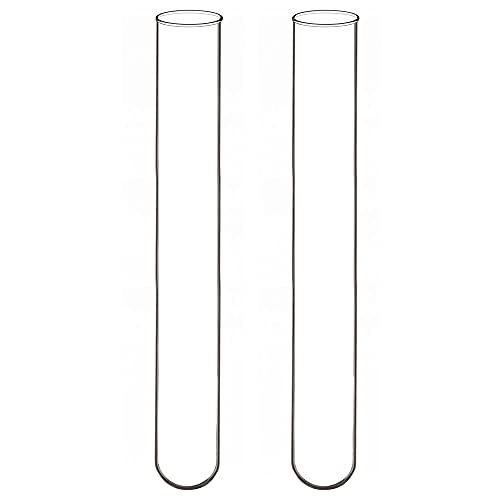
The Labasics set features borosilicate glass tubes with 20 mm outer diameter and 150 mm length, offering high thermal resilience. The cylindrical bottom design aids uniform heat distribution during heating and reactions. Its borosilicate composition provides better resistance to thermal shock, making it suitable for laboratory demonstrations and long-term storage of heated samples. The kit’s 20-tube configuration ensures a steady supply for classrooms or small-scale experiments.
Ronyes Lifescience Glass Tubes with Stoppers

This pack includes glass test tubes sized at 150 mm by 20 mm, with a total capacity around 36 ml. The included rubber stoppers provide a simple sealing option for reactions or storage of volatile samples. The durable glass construction supports a range of laboratory tasks from simple demonstrations to more involved experiments. The set is designed for users seeking a reliable, sealed solution without frequent substitutions.
Thyle 100 Pcs Glass Tubes with Cork

Thyle offers a bulk option with 100 glass test tubes, each about 20×105 mm, plus a cork closure and a transport tray. The relatively short length makes them ideal for experiments, classroom storage, or educational demonstrations where compact samples are stored upright. The low-borosilicate glass provides basic heat resistance, and the corks help minimize leakage while enabling easy access during experiments. The included tray aids organization and transport.
16 Pcs Plastic Test Tubes with Cork

These plastic test tubes are 20 mm in diameter and 150 mm in length, offering 30 ml of capacity per tube. Made from clear acrylic-like polymer, they are lightweight and shatter-resistant, with cork stoppers for a reasonable seal. A practical choice for propagation, storage of beads or small craft items, and classroom activities where breakage is a concern. The set includes 16 tubes along with two brushes to aid cleaning.
Oungy 60 Pack Plastic Test Tubes

These 60 plastic test tubes by Oungy feature 35 ml capacity with clear PS plastic that resembles glass in clarity while offering impact resistance. Each tube comes with a cork stopper to enhance sealing, ideal for non-liquid contents and safe handling for children. They’re suitable for DIY bath salts, candy storage, and decorative party uses, where durability matters as much as visibility. The set emphasizes portability and ease of storage, making it a versatile option for quick projects.
Buying Guide: Key Considerations When Choosing 20 Mm Test Tubes
Material type matters: Glass tubes, especially borosilicate, perform better under heat and chemical exposure compared with standard glass. Plastic tubes offer shatter resistance and lighter weight, suitable for classroom use and non-hazardous contents.
Tube dimensions and capacity: A 20 mm diameter with 150 mm length is common, but some sets feature shorter lengths. Consider your intended contents to determine whether a 30 ml or larger capacity is preferable, and whether upright storage is important for your setup.
Sealing options: Cork stoppers, rubber stoppers, or flat-bottom designs influence leak resistance and ease of use. Cork closures typically seal well for dry materials; rubber stoppers are convenient for liquids. Flat bottom can improve stability during display or storage.
Thermal tolerance: For demonstrations that involve heating or hot liquids, choose tubes with higher heat resistance. Borosilicate glass tubes generally withstand higher temperatures and rapid temperature changes better than standard glass.
Durability and safety: Plastic tubes reduce risk of breakage but may have lower chemical resistance and clarity compared to glass. If the experiment involves aggressive reagents, glass with proper sealing is often preferred.
Ease of cleaning and maintenance: Tubes with smooth interiors and optional brushes simplify cleaning, especially after multiple uses. Plastic tubes may be easier to rinse but can retain residues if not properly cleaned.
Use-case alignment: For classroom demonstrations, consider a larger pack with corks for easy sealing and safe handling. For storage or display of beads, salts, or crafts, a transparent plastic option may be best.